
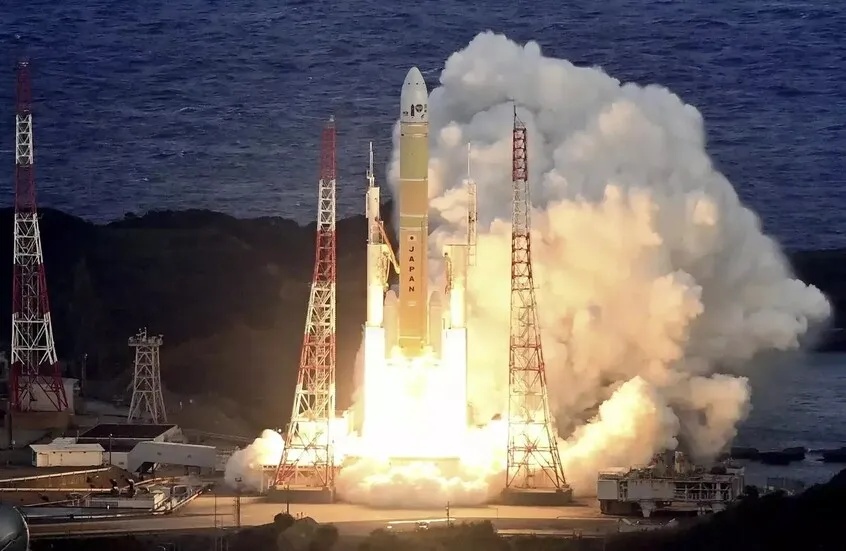
The Japan Aerospace Exploration Agency (JAXA) announced the successful launch of the sixth satellite for its "Michibiki" (meaning "guidance") spatial positioning system. The satellite was deployed into orbit aboard the heavy-lift H3 launch vehicle from the Tanegashima Space Center in
southwestern Japan. This achievement follows a previous failed attempt last December, when a launch vehicle's second stage malfunctioned prematurely, preventing an earlier Michibiki satellite from reaching orbit. That incident caused multiple postponements for the current satellite's launch. Japan currently has five Michibiki
satellites in orbit. The system requires a minimum of seven satellites to function efficiently as a comprehensive national positioning system, designed to complement and enhance the accuracy of the American Global Positioning System (GPS). By the mid-2020s, the number of Michibiki
satellites is projected to reach 11. This expansion is expected to significantly reduce Japan's reliance on GPS and better serve its own needs, as well as those of the wider Asia and Pacific regions. The Japanese Positioning System (QZSS) is distinguished
by its highly encrypted signals, offering robust protection against jamming. Beyond civilian applications, Japan's military and intelligence agencies are also expected to benefit. These satellites can pinpoint object coordinates on Earth's surface within their coverage area with an accuracy of
approximately 6 centimeters, significantly outperforming GPS, which typically offers about 10 meters.