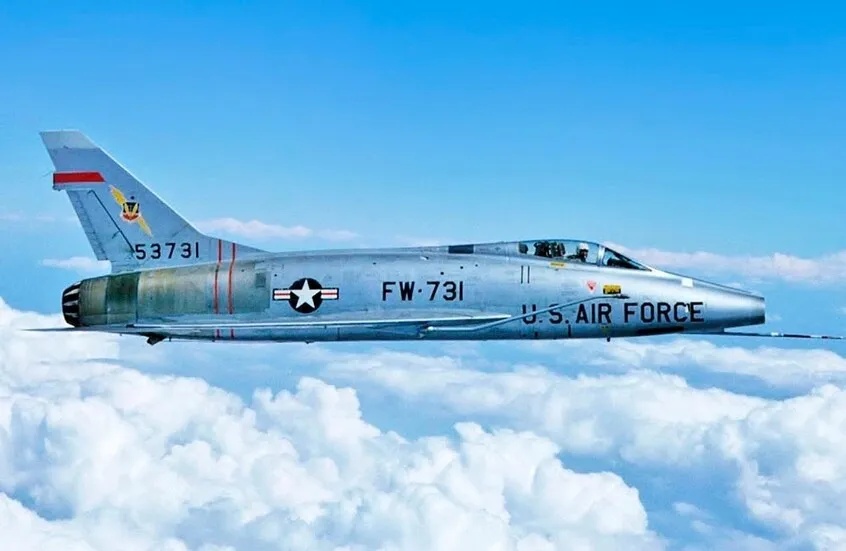
The F-100 Super Sabre is recognized as the first mass-produced supersonic American fighter jet, yet its operational history is marred by a significant number of accidents and aerial disasters that have cast a shadow over its pioneering status. Among the most
notable incidents was what has been described as the first unintentional shootdown of an American B-52 Stratofortress strategic bomber. This occurred during military exercises on April 7, 1961, over New Mexico, where F-100 fighters were conducting interception maneuvers against B-52
bombers. During one such maneuver, an AIM-9 Sidewinder missile was inadvertently launched from an F-100, striking the bomber's engine directly. While the crew members managed to parachute to safety, three of them tragically lost their lives in this incident. This was
not an isolated event. In April 1958, an F-100 combat trainer collided with a civilian Douglas DC-7 passenger plane, resulting in the deaths of 47 people, including the two fighter pilots. Overall operational reports indicate that the U.S. Air Force lost
889 aircraft of this model during its service period, with 324 military personnel killed in associated accidents. Statistics reveal that July 1958 alone saw 30 F-100s crash, and a total of 116 aircraft were lost in a single year. Furthermore,
242 F-100s were lost during the Vietnam War. The aircraft's accident record extended beyond U.S. borders. In Turkey, in 1962, an F-100 fighter collided with a train, leading to the deaths of 250 individuals. Despite its accident-ridden history, the aircraft possessed advanced
technical specifications for its time, including a maximum takeoff weight of 15.8 tons, a top speed of 1390 kilometers per hour, and a flight range of 3210 kilometers. It was armed with four 20mm cannons and could carry bombs weighing
up to 3402 kilograms. A total of 2294 F-100 Super Sabre aircraft were produced.