
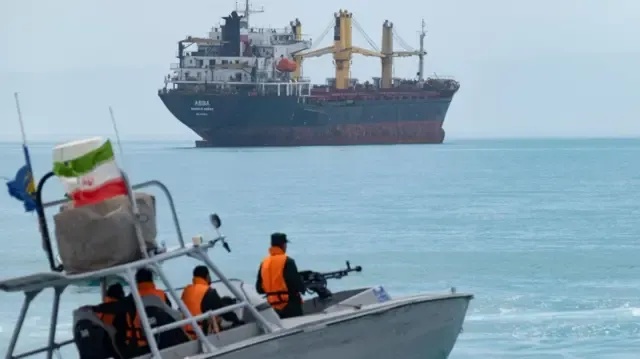
Britain and France are finalizing plans to lead an international mine clearance mission in the Strait of Hormuz, following days after a U.S.-Iran agreement to end the conflict and reopen the vital waterway. Maritime navigation in this crucial trade route remains
largely halted due to previous U.S.-Iran clashes. Efforts continue for a temporary accord restoring pre-crisis shipping levels. Informed sources reported significant progress by military planners from several nations in unifying efforts to remove naval mines allegedly laid by Iran's Revolutionary Guard. The
mission involves a 15-nation coalition that has already allocated personnel and military resources. Anonymous sources indicated these nations might join weeks after launch to reassure commercial vessels. Despite extensive planning, countries still seek additional equipment, especially support ships. Deployment commences only
after a U.S.-Iran agreement restoring full, unobstructed commercial navigation rights, and providing a favorable environment for military assets in the Strait, sources said. On Wednesday, U.S. President Donald Trump downplayed the threat of Iranian naval mines to navigation, asserting U.S. forces
had "removed most." A day prior, U.S. Secretary of State Marco Rubio informed Senators that Iran had planted mines in significant parts of the Strait. Trump affirmed the Strait would reopen "immediately" upon Iran signing an MoU to cease hostilities. However,
both nations face difficulties reaching terms. On Thursday, Iranian Foreign Minister Abbas Araqchi stated no progress in talks, coinciding with ongoing Israeli escalation in southern Lebanon. **European Ambition for a Leading Role** This planning reveals European powers' desire for a key role
in Gulf stability and security, once the U.S. and Iran agree to end waterway hostilities. Europe largely refrained from supporting Trump's military campaign, leading him to criticize continent leaders and NATO for not endorsing his aggressive approach. British Foreign Secretary Yvette Cooper
stated this week the mission was discussed with the U.S., aiming to "ensure additional mine clearance capabilities wherever needed, and to provide necessary support for guarding ships or securing shipments when required." Sources clarified the British and French mission would be
ready to open communication with Tehran on operational matters. Despite Iran's expressed desire to clear mines itself, Britain and France doubt its adequate capabilities, preferring to manage the survey and clearance operation themselves. In late May, the Royal Navy announced deployment
of the RFA Lyme Bay, equipped with autonomous mine detection systems, from Gibraltar towards the Strait. The United States currently lacks dedicated mine countermeasures vessels in the region, withdrawing its remaining fleet of four Avenger-class mine sweepers. However, two Littoral Combat
Ships, USS Tulsa and USS Santa Barbara, are in the Indian Ocean and Gulf, and can be outfitted for mine clearance, per U.S. Naval Institute data.