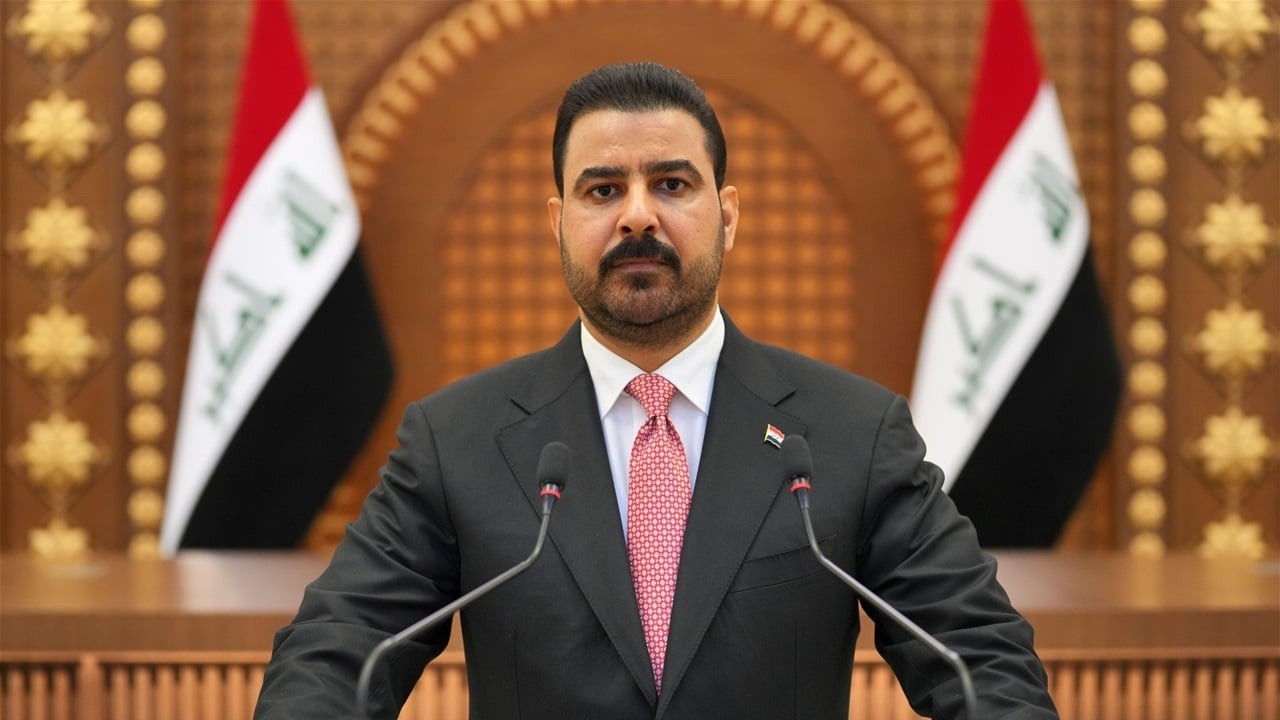
Political Prime Minister Ali Al-Zaidi set Thursday, June 30, 2027, as the final deadline to address the issue of weapons outside state control. Al-Zaidi said in a statement, "We congratulate the Iraqi people on this great day, October 1, 2026,
and the great national achievement of the end of the international coalition's mission in Iraq, the complete and final withdrawal of its forces (by land, air, and sea), and the realization of full and comprehensive Iraqi sovereignty." He explained that
"achieving comprehensive national sovereignty is a great national achievement that all Iraqis are proud of, which was realized by the grace of Almighty God and the prominent and important role of the supreme religious authority, which mobilized zealous Iraqis to
defend their country through the fatwa of sufficient jihad, which was carried by our loyal masses and active forces of the Iraqi people, and they formed the nucleus of confrontation from the sincere and factions that had a role in
launching the confrontation against ISIS, side by side with all the armed forces, and these entities played their role in all the difficult stages through which our dear homeland passed." He pointed out that "October 1, 2026, is considered a
serious beginning to address the issue of weapons outside state control, and adherence to constitutional entitlements, according to a clear roadmap and agreed-upon timelines not exceeding June 30, 2027, and in accordance with the constitutional principle requiring that the decision
of war and peace be left to the constitutional authorities, and preventing any military action contrary to that," noting that "the government will work, in accordance with the constitution, to completely disarm all non-Iraqi armed groups present on Iraqi territory,
in a way that preserves the country's security and stability and secures its borders." He continued that "the Iraqi government affirms its constitutional commitment to prevent the use of Iraqi land and airspace as a starting point or corridor for
any act that threatens the security of neighboring countries, and it also rejects the use of any country's land or airspace to attack Iraq, based on the principles of mutual sovereignty, good neighborliness, and non-interference in internal affairs," pointing out
that "the government will initiate supporting security institutions by purchasing a complete air defense system, to enhance the full aerial sovereignty of the Iraqi state, and legislate the Popular Mobilization Law and establish its position in the security system, as
an integral part of it under the command of the Commander-in-Chief of the Armed Forces." He affirmed that "as Iraq ends this long phase of wars, confronting terrorism, and violating national sovereignty accompanied by massive sacrifices paid from the pure,
dear blood of Iraqis, Iraq looks forward to a new phase to achieve full national sovereignty, enhance civil peace, stability, and prosperity, direct state capabilities and resources towards sustainable development, improve the lives of citizens, provide necessary services, and build
a safe and stable future for future generations." He also affirmed that "October 1 represents the beginning of a new phase in Iraq's journey as a fully sovereign state, strong in its institutions, governed by the constitution, law, and principles
of international law, and opening up to its regional and international surroundings with balanced relations based on mutual interests and respect."