
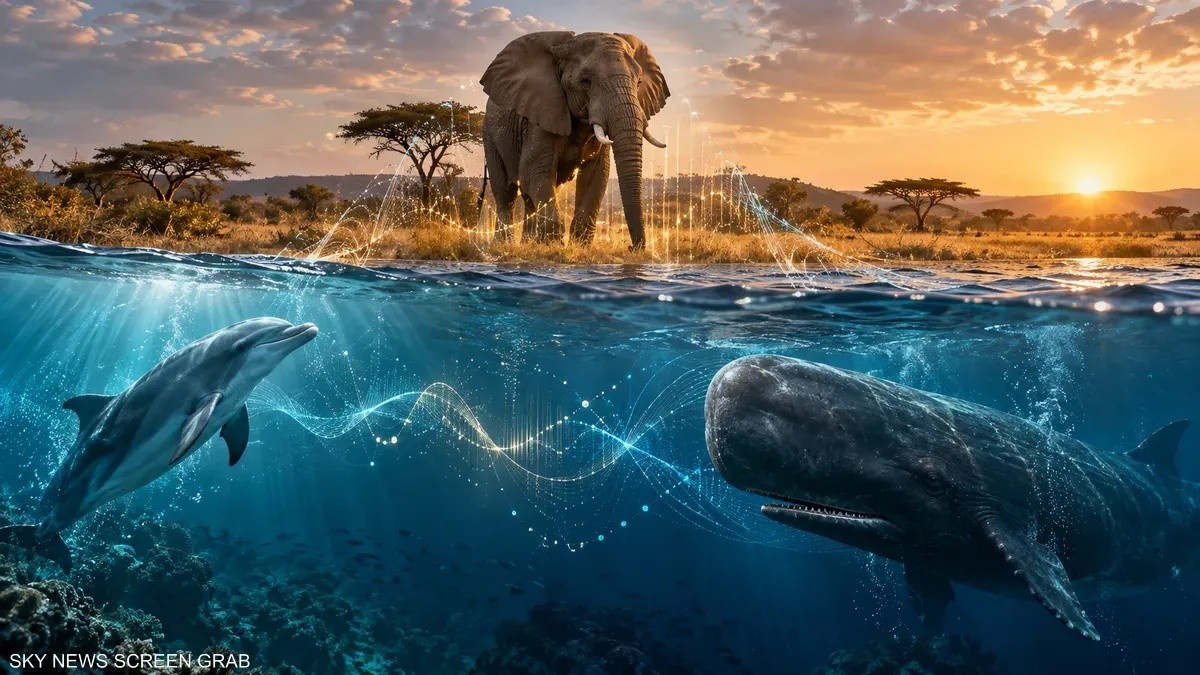
Despite the rapid advancements in artificial intelligence, which have enabled it to analyze complex vocal patterns in dolphins, elephants, and whales, the ability to understand these sounds and translate them into human language remains a significant challenge. While AI can
detect and recognize precise repetitions, comprehending the underlying meanings is still out of reach. This scientific field faces a fundamental gap separating the mere identification of sounds from the understanding of their true significance. An AI system might observe the recurrence
of a specific call when an animal approaches or a threat appears, but this statistical correlation is insufficient to prove that the call means "come closer" or "danger" in the human sense. This challenge raises deeper questions about how close
AI truly is to grasping what animals genuinely mean, or if it merely presents persuasive patterns that we might misinterpret. The "Dolphin Gema" project, a collaboration between Google, the Wild Dolphin Project, and the Georgia Institute of Technology, stands out as
a leading effort in this regard. This advanced model was trained on a vast database of dolphin recordings, allowing it to analyze their sounds, identify recurring sequences, predict future calls, and even generate sounds mimicking original dolphin vocalizations. However, these
capabilities do not imply that the system understands the inherent meanings of these sounds. Predicting the next sound is much like the ability of human language models to anticipate the next word in a sentence; this alone does not confirm
an understanding of the animal's emotional experience or what it is trying to express. Research teams aspire for these tools to help establish clear links between dolphin sounds, their behavior, and contexts, with the aim of gradually building a limited
shared vocabulary between humans and these marine creatures. Nevertheless, the project does not claim to possess a comprehensive real-time translation technology for dolphin language. In another context, a notable study published in the journal "Nature Ecology & Evolution" revealed the potential
for African savanna elephants to use individual calls resembling names when addressing a specific elephant. Researchers utilized machine learning techniques to analyze a wide range of these calls. To validate their hypothesis, they conducted experiments involving playing sound recordings to
elephants, observing that the targeted elephant showed a stronger and clearer response to the call directed specifically at it, compared to calls directed at other elephants. While these findings provide compelling evidence for the inclusion of recipient-specific information within certain
calls, they do not in any way mean that scientists have reached the stage of translating full conversations between elephants or deciphering all the messages they convey. Furthermore, within the framework of the "Project CETI" research, scientists have meticulously studied thousands
of short clicks that sperm whales use as a primary means of communication. Their precise analysis of these clicks revealed organized and varying patterns in their rhythm, speed, number, and distinctive vocal additions. A study published in "Nature Communications" concluded
that these vocal components combine in diverse and complex ways, suggesting that whale calls possess a far more intricate organizational structure than previously thought. However, the researchers themselves frankly admit that they still do not know the semantic content of
what these whales are saying. The mere discovery of an alphabet-like structure does not automatically translate into understanding the specific words or meanings that the animals seek to convey. Here arises the risk of falling into the trap of "illusory translation,"
where AI might identify a correlation between a specific sound and an accompanying behavior, but this correlation may not represent the true meaning behind the call. Animal vocalizations can be influenced by multiple factors such as the animal's identity, age,
emotional state, and surrounding environment, and do not necessarily carry a single, direct message that can be literally translated. Moreover, communication among animals is not limited to the auditory component alone; it extends to other complex forms such as body
movements, touch, scent release, postures, and visual signals. Consequently, studying sound recordings in isolation from these integrated elements may lead to incomplete or even misleading interpretations. These limitations should not be misunderstood as a failure of artificial intelligence; on the contrary,
AI has provided researchers with unprecedented analytical capabilities to sort through vast amounts of recordings and discover subtle patterns that were difficult for the human eye to notice. Machines have become capable of detecting auditory details that were previously inaudible
to us, but they have not yet proven their ability to understand them. Until this qualitative leap occurs, the "animal translator" remains a promising scientific dream that sparks curiosity, rather than a tangible reality within our grasp.