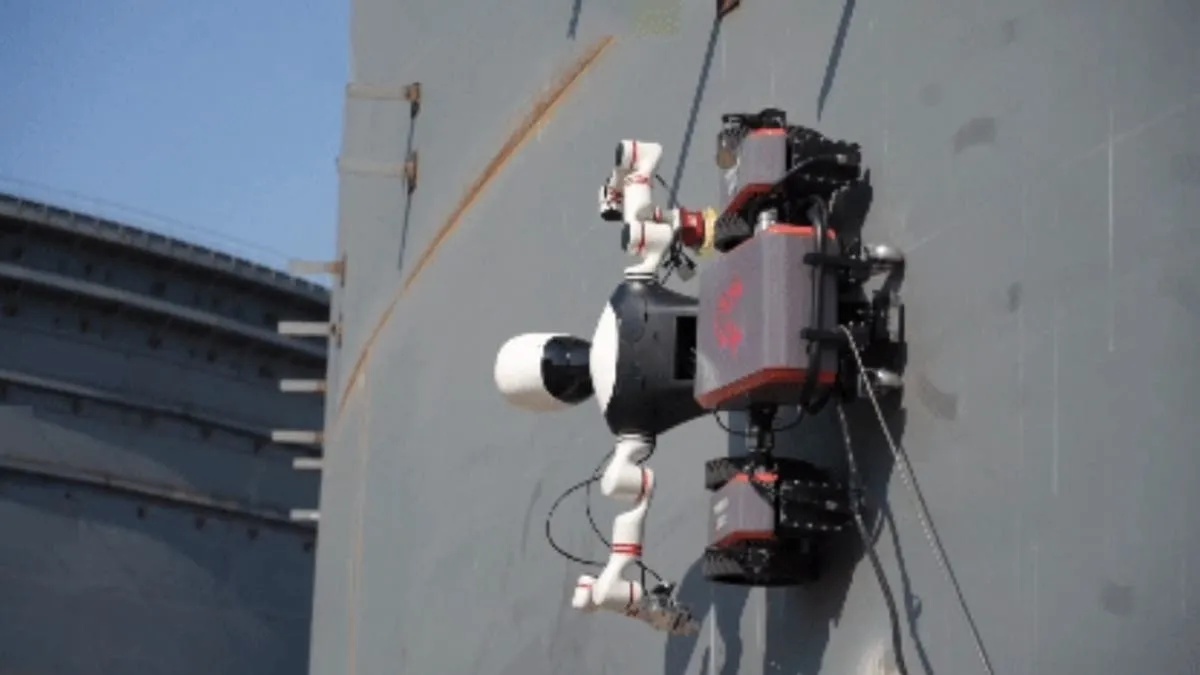
China is moving towards expanding the use of robots into new fields, with the development of advanced technologies capable of carrying out maintenance work in high and hazardous environments. The latest of these innovations are self-climbing robots, specifically designed for
cleaning ship hulls and effectively removing rust with enhanced safety. In this context, the Chinese company "Robot++", headquartered in Zhejiang province, has developed a robot capable of moving smoothly across ship surfaces and performing complex maintenance tasks. This development aims to
significantly reduce the severe risks faced by workers in such environments, in addition to substantially improving the overall efficiency of operations. The company announced that this innovative robot can cover over 98% of a ship's massive hull. It also indicated that
it boosts cleaning efficiency fivefold compared to currently employed traditional methods, while achieving a significant cost reduction ranging between 30 and 50 percent. Ship maintenance operations face considerable challenges due to their enormous sizes; some vessels with a deadweight tonnage of
up to 100,000 tons exceed 21 meters in height, and their lengths extend to approximately 250 meters. These colossal dimensions make cleaning and rust removal exceptionally arduous and hazardous tasks for human personnel. For his part, Xu Huayang, the company's founder,
explained that the shift towards developing robots specialized in high-altitude work came in response to intensified competition in the industrial robotics and drone markets. He noted that robotic applications in this particular field still require more sophisticated and innovative solutions.
He added that the company, founded in 2015, has deployed its robots in over 100 shipyards, both within China and internationally. The uses of these advanced robots are not limited to cleaning ships; they also extend to performing welding tasks, non-destructive
testing, rust removal, as well as maintaining towering building facades and complex petrochemical industry tanks. The company relies on the latest artificial intelligence technologies to enhance the performance of its robots, utilizing advanced machine learning models that enable the machines to
understand their surrounding environment and interact with it intelligently. The company has announced that its robots have so far recorded over 100,000 operating hours and performed work over a total area exceeding 5,000 square kilometers. Analysts in this field believe that
these advanced technologies could play a pivotal role in addressing the labor shortages experienced in hazardous jobs, especially with the decline in the working-age population and the increasing urgent need for technological solutions that reduce reliance on human effort in
demanding and risky tasks.