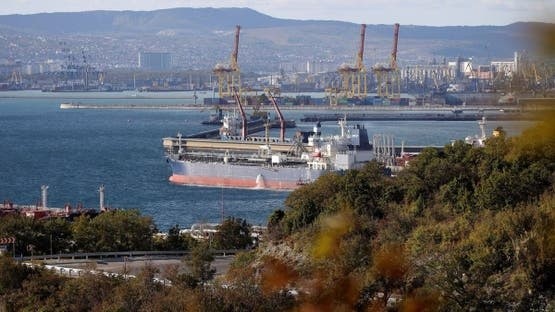
Oil prices witnessed a decline during Monday trading, affected by US President Donald Trump's decision to exempt Russia from a package of sanctions and tariffs, which could contribute to increasing the volume of Russian fuel exports to global markets. Brent
crude futures recorded a drop of 2.02 dollars, equivalent to 1.84 percent, reaching 107.84 dollars per barrel by 0418 GMT, following its close in the past Friday session at its highest level recorded since the nineteenth of May. In the
same context, US West Texas Intermediate crude reached 97.40 dollars per barrel, recording a decrease of 1.62 dollars or 1.64 percent, after finishing Friday trading at its highest point since the seventeenth of September. The US President had signed an
executive order last Friday including exemptions from basic sanctions and tariffs approved under the Graham Act, which was signed during the past month in response to demands from lawmakers seeking to intensify pressure on Moscow against the backdrop of its
military operations in Ukraine. Nevertheless, Secretary of State Marco Rubio indicated that the US administration will adopt a period of up to sixty days to study and evaluate the economic repercussions of these sanctions and tariffs on the global economy.
These developments come following Trump reaching an understanding with Russian President Vladimir Putin stipulating the export of diesel to the United States and other markets, where shipments are scheduled to start at about 2.3 million barrels during the current month
before gradually rising to reach about 7.6 million barrels monthly, based on the official statements of the US President. In contrast, Ukrainian President Volodymyr Zelensky expressed his objection, stressing that these US measures will negatively reflect on his country's interests.
It is worth mentioning that Brent crude had briefly touched the level of 110 dollars per barrel during Friday trading for the first time since May, amid fears raised by ongoing tensions and security threats in the Middle East region
related to the safety of shipping lanes and the tightening of global energy supplies. In this regard, Tim Waterer, market analyst at KCM Trade, explained that the combination of a more flexible approach regarding the sanctions file and selling movements
aiming to secure profits following recent gains contributes to limiting the upward momentum in the near term. He added that the exemption step may support Russian fuel exports, but the divergence of official messages has produced a clear state of
uncertainty in the markets. He noted that markets will likely not price in a sustainable increase in supply until details and timeframes are clarified accurately. Moreover, Kepler analytics firm reported in a note published on Friday that the escalation in
attacks targeting commercial ships led to a sharp drop in crude flows coming from the Gulf to settle at about 8.5 million barrels per day as an average over seven days of the past week, compared to more than 20
million barrels per day recorded in the week that preceded it. The company mentioned that at least ten confirmed incidents targeting commercial ships were monitored during the past week. On another level, Egypt confirmed its full readiness to provide all
means of support needed by the Kingdom of Saudi Arabia to defend its security and internal stability.