
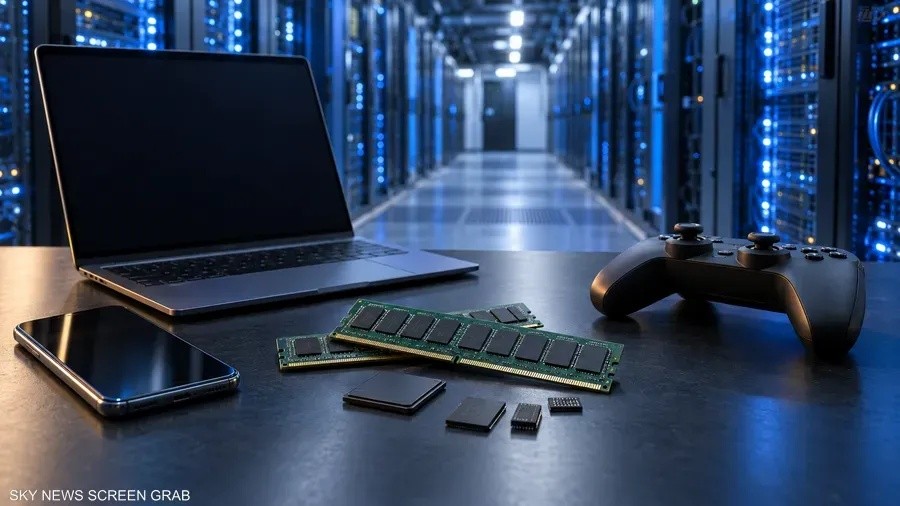
The rapid advancements in artificial intelligence are now directly impacting the prices of electronic devices, as data centers increasingly monopolize memory chip supplies. This shift has left manufacturers of smartphones, personal computers, and gaming consoles grappling with severe component shortages
and a sharp rise in production costs. Reports indicate that the prices of certain memory chips, particularly Dynamic Random-Access Memory (DRAM), have surged by up to five times within a single year, according to a report by the "Financial Times." Projections
suggest that supply disruptions and price increases will persist until 2027. This scarcity does not stem from AI applications directly consuming phone or computer chips; rather, it results from semiconductor companies reorienting their production towards more advanced and lucrative types,
which are essential for AI servers and large-scale data centers. Advanced AI models necessitate vast amounts of data that must be stored and processed at extremely high speeds. This requirement has led to a significant increase in demand for High-Bandwidth Memory
(HBM), alongside advanced variants of DRAM and NAND storage. Companies produce these sophisticated types using the same factories and production lines that also serve the traditional chip market. With a larger portion of manufacturing capacity now dedicated to meeting the
demands of data centers, the available supply for phones, computers, and other electronic devices has considerably shrunk. Consequently, AI is not competing with the consumer for the finished device, but rather with the manufacturer for the fundamental chips embedded within
it. TechInsights, a research firm, described the current situation as one of the most severe memory shortages in the sector's history. The firm highlighted that the demand linked to AI data centers is escalating at a pace faster than companies' ability
to add new production lines. Facing these rising costs for memory chips, which are crucial components in smartphones, computers, tablets, and gaming platforms, manufacturers are left with two options: either increase the price of their devices or reduce specifications to maintain
existing price points. The crisis has prompted some electronics companies, as per the "Financial Times," to raise product prices by up to 20 percent, while the cost of certain gaming devices has seen an increase of approximately $150. Low-cost device manufacturers
are particularly vulnerable to these pressures due to their limited profit margins, which cannot absorb the substantial rise in component costs. Conversely, larger companies may opt to focus on higher-priced, more profitable devices instead of budget models. Consumers are likely
to feel the impact of this crisis through more expensive electronic devices, new models featuring less memory than anticipated, or older devices remaining on the market for extended periods. This crisis cannot be resolved quickly by merely activating additional production lines
within a few months. Establishing and equipping semiconductor factories and achieving full production efficiency requires years and colossal investments estimated in billions of dollars. Although memory manufacturers are working to expand their production capacity, a significant portion of these new
investments continues to be directed towards advanced AI-specific chips, which yield higher returns compared to traditional memory. Estimates from IDC indicate that the growth rate of DRAM and NAND supplies through 2026 will remain below historical levels, with the potential for
the shortage's repercussions to continue until 2027. While this does not imply that all phone and computer prices will rise uniformly—as the impact depends on the memory size in each device, contracts between companies and suppliers, and manufacturers' capacity to
absorb part of the cost—the general trend is clear: the boom that has made AI more powerful may also make the everyday devices consumers use more expensive.