
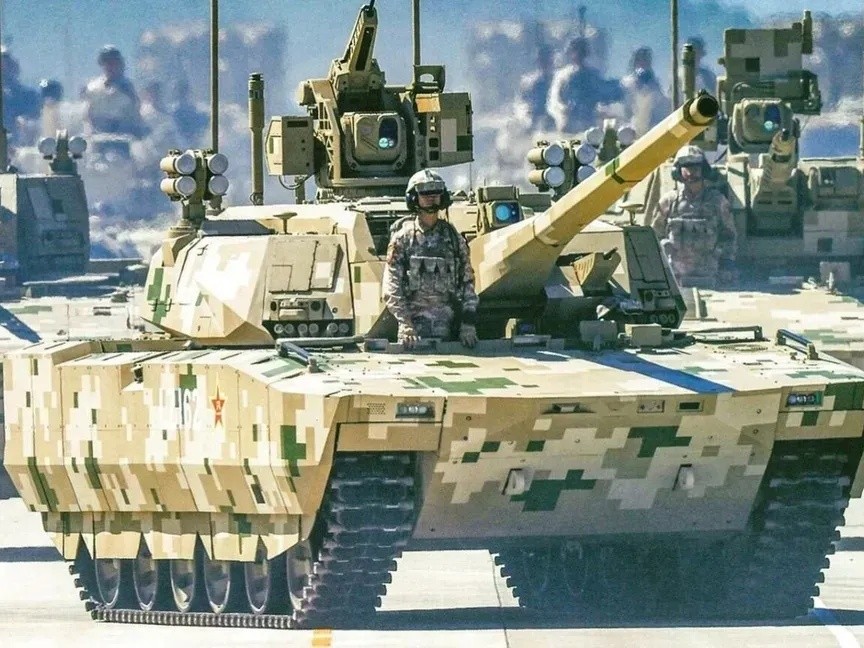
Chinese defense research specialists have formulated a comprehensive and ambitious long-term conceptual framework for an advanced electric main battle tank. The proposed platform weighs approximately sixty tons, incorporates a compact modular nuclear reactor as its primary power source, and is
armed with an electromagnetic railgun delivering an energy discharge of fifty megajoules. Technical timelines outlined for this visionary defense development project suggest that its operational maturation will likely extend well beyond the year 2045. The strategic conceptual study was authored
by an expert technical team representing the Inner Mongolia First Machinery Group—a core pillar within China's defense industrial apparatus that plays a prominent role in armored vehicle design and manufacturing—in partnership with the State Key Laboratory of Special Vehicle Design
and Manufacturing, alongside scientists from the Beijing Institute of Technology. The complete findings were documented in a research paper published in the June 2026 supplement of the Chinese specialized defense periodical Acta Armamentarii. The architectural roadmap devised by the engineers
details a three-stage progressive transition. The inaugural phase, targeted for implementation before 2035, entails mounting emerging electromagnetic weapon systems directly onto current armored platforms while preserving traditional diesel propulsion systems. Under this arrangement, a proposed 1,500-horsepower diesel power unit will
be integrated with supercapacitors and a flywheel energy storage system to supply the massive instantaneous electrical surges needed for firing. This initial iteration is designed around a 10-megajoule electromagnetic weapon capable of reaching a theoretical firing range of approximately 150
kilometers, accompanied by an electromagnetic armor protection system drawing about 2 megajoules of operational energy to enable real-world field evaluations without the immediate necessity of an onboard nuclear installation. Entering the second evolutionary phase, envisioned to span until 2045, the
electromagnetic cannon's power rating is slated to increase to roughly 20 megajoules, extending its anticipated strike reach to nearly 300 kilometers. Concurrently, the electromagnetic shielding capability will be substantially reinforced, consuming an estimated 10 megajoules of electrical power. Power delivery
during this phase will rely on a diesel generator producing 2,000 horsepower, supported by roughly five tons of specialized energy storage hardware. The project reaches its ultimate form during the concluding stage with the introduction of modular atomic power. Researchers
envision equipping the vehicle with a 10-megawatt small modular reactor utilizing liquid-metal cooling technologies, engineered specifically to occupy an interior envelope of roughly two cubic meters. This nuclear core will deliver consistent, robust electrical energy to all onboard systems, primarily
driving the ultimate 50-megajoule railgun. Projected projectile velocities are estimated at 3.5 kilometers per second, yielding an extreme theoretical engagement range of roughly 450 kilometers. Such exceptional range shifts the platform’s combat role into a hybrid asset combining frontline direct-fire
engagement with long-range precision bombardment. This conceptual project places significant technological emphasis on integrated energy solutions, viewing supercapacitors, advanced battery cells, and superconducting storage mechanisms as vital steps toward powering the next generation of ground warfare. The study reflects the
escalating technological self-assurance within China’s defense manufacturing establishment, following Beijing’s operational introduction of the Type 100 platform—the world’s first fourth-generation main battle tank—alongside parallel advancements toward fielding sixth-generation combat aircraft well ahead of global peers. Nonetheless, while developing a nuclear-powered
armored vehicle appears theoretically feasible, serious questions remain regarding economic and operational viability. Modern land warfare, notably illustrated by battlefield dynamics during the Russian campaign in Ukraine, demonstrates that sheer heavy firepower is increasingly secondary to rapid drone networking, robust
mobility, and active protection systems—tactical capabilities that continue to define contemporary armored doctrine.