
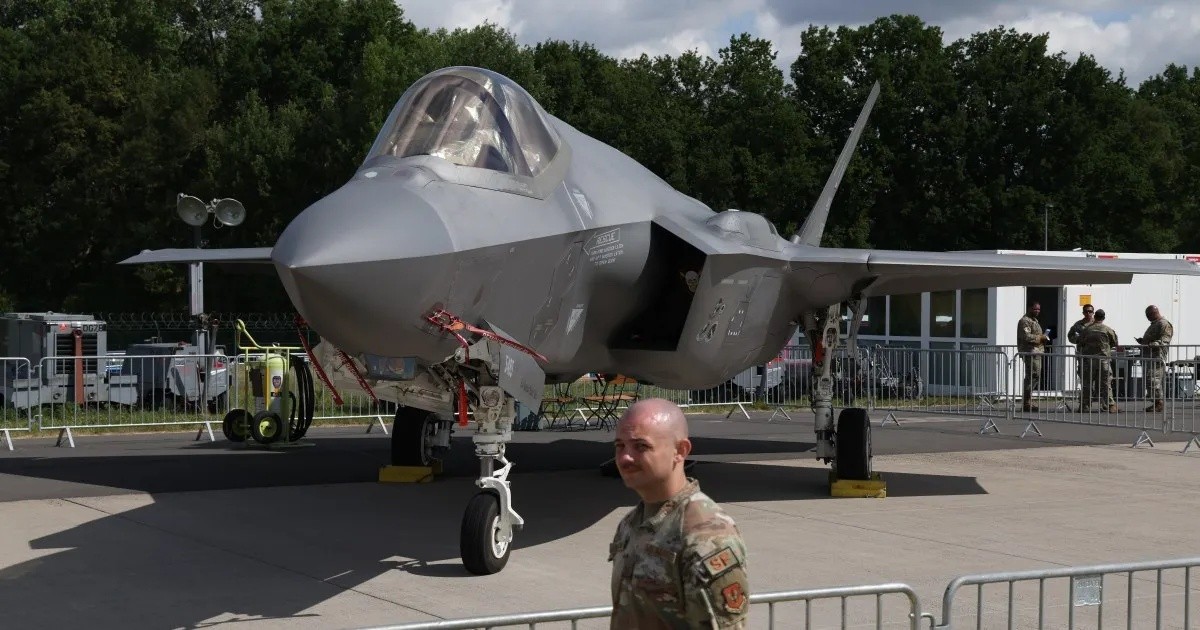
The U.S. Congress is currently engaged in an extensive investigation into the rerouting of a shipment containing highly sensitive F-35 fighter jet components to Hong Kong last summer. The inquiries are focused on examining the potential exposure of advanced military
stealth technology to foreign entities, particularly China. Details from individuals familiar with the incident reveal that F-35 parts were en route from Australia to the United States for necessary repairs. However, the shipment's trajectory mysteriously altered during its transit across the
Pacific Ocean, ultimately ending up in Hong Kong. The U.S. Department of Defense has confirmed the disappearance of some of these components, yet the reasons behind the shipment's diversion and the current whereabouts of the parts remain unknown. The missing shipment,
which was transported by a broker on behalf of Lockheed Martin, the fighter jet's manufacturer, included a cockpit canopy. This vital component incorporates stealth technology exclusively available to the United States and its allies. According to two individuals briefed on
the incident, this development raises concerns that adversarial parties could study these parts, potentially gaining an opportunity to reverse-engineer this highly classified technology. For its part, the F-35 Joint Program Office (JPO) at the U.S. Department of Defense has acknowledged "an
issue with a shipment of unserviceable F-35 Lightning II components." The JPO affirmed its close collaboration with U.S. authorities and industry partners to recover the missing components, conduct a thorough investigation into the incident, and establish stringent preventative measures to
ensure such occurrences are not repeated in the future. The redirection of the shipment to Hong Kong, a special administrative region of China, signifies its entry into Beijing's direct sphere of influence. Concerns are further amplified given China's history of engaging
in extensive espionage operations targeting secret Pentagon military programs, including the F-35 program itself. In this context, Jay Jay Giertler, a former military aviation analyst at the Congressional Research Service and a former staff member on the House Armed Services Committee,
stated that China has extensively sought F-35 data through cyber espionage and other means. Giertler indicated that possessing an actual physical part of the fighter jet could provide valuable additional information, either to verify previously gathered data or to enhance
it. The complex F-35 supply chain relies on a vast network of parts transfers and repairs conducted through facilities located in multiple countries. Although Australia hosts F-35 maintenance facilities, none are currently capable of repairing canopies. Lockheed Martin holds overall responsibility
for managing the program's critical supply chain and utilizes commercial shipping companies for parts transport. Lockheed Martin, for its part, affirmed its inability to discuss the status of shipments due to security reasons. However, it emphasized its full compliance with all
U.S. regulations concerning the shipment of aircraft components, clarifying that its teams handle every shipment under strict protection procedures to ensure the integrity of the F-35 program and the security of its allied partners. The F-35 cockpit canopy is a pivotal
component in achieving the advanced stealth capabilities of these aircraft. This canopy consists of an acrylic dome covering the pilot's compartment, coated with a thin, transparent layer of a special radar-absorbent material that helps conceal the aircraft from enemy radars.
This protective layer can degrade over time, necessitating periodic repair or replacement of canopies within a fleet exceeding 1,300 fighter jets produced for the United States and its allies. In a related development, the U.S. State Department declined to comment on
the incident, while the Chinese Embassy stated it had no knowledge of it. The collaborative F-35 program includes the United States and several allied nations, among them Britain, Australia, Denmark, Norway, and Poland. This program operates on a shared parts management
system, enabling participating countries to access a unified spare parts inventory stored at various locations worldwide. Ownership of these parts remains with the U.S. Department of Defense until they are installed on the fighter jet. Despite efforts by the Department of
Defense to enhance its oversight of the F-35 supply chain in recent years, it does not record spare parts held in the shared inventory. Lockheed Martin continues to oversee the management of this inventory. A report issued by the U.S. Government
Accountability Office (GAO) in 2023 revealed that over one million F-35 spare parts were lost over the preceding five years. The report indicated that the Department of Defense was unable to review losses of spare parts, valued at tens of
millions of dollars, due to Lockheed Martin's control over information related to these components.